The Test of English as a Foreign Language (TOEFL) is the standardized test by which the English-language skills of non-native speakers are evaluated. The test is required by most colleges and some employers to make sure students and employees are capable of handling the linguistic challenges of cultural immersion. The test is designed by the Center for Applied Linguistics and administered by the Educational Testing Service.
From 1964 until 1998, test-takers took the TOEFL paper-based test, which was given like a traditional exam. This test was originally based on discrete-point testing, which tests one particular area of language knowledge per question and extrapolates a score that gives an overall view of the student's level. The paper-based test was scored from 310 to 677. However, as linguistic models changed, the Educational Testing Service (ETS), which administers the TOEFL, decided to change the test format as well.
Started in 1998, the computer-based TOEFL test kept some discrete-point questions, but also tested vocabulary and other skills directly. The computer-based test worked on an adaptive model: the questions a student saw depended on his answers to the first question in a given section. If he got the first few questions wrong, he would receive easier questions and thus a lower score. The computer-based test was scored on a scale of 0 to 300 points.
In 2005, ETS began to phase out the computer-based test in favor of the current Internet-based test. This test contains no discrete-point questions and is not adaptive: all students see the same questions, regardless of whether or not they answer the first questions correctly. The TOEFL Internet-based test appeared first in the United States, Canada, France, Germany and Italy in 2005, before gradually spreading to other parts of the world in 2006. It is scored on a scale of 0 to 120.
1.Background
Based in Washington, D.C., the Center for Applied Linguistics (CAL) is a nonprofit organization committed to researching the relationship between language and culture. Founded in 1959, its first director was Charles A. Ferguson (1921-1998), who had administered similar programs in the Middle East and taught as a professor at Harvard University. Ferguson guided the center to develop practical solutions for the applied language and literacy concerns of international and national governments.
2.Origin
One of Ferguson's earliest projects was to develop a test that would quantify the command of the language that ESL (English-as-a-Second-Language) students and government employees had. Ferguson and fellow applied linguistics researchers developed the TOEFL test for the first five years of the CAL. In 1964, the first official TOEFL test was taken at the center.
3.Development
Since the late 1960s, the TOEFL test has been administered by the Educational Testing Service (ETS), an international standardized-testing organization. According to ETS, between 1964 and 2008, 24 million people, largely international students, have taken the test. Introduced in 2005, the Internet-based test has replaced the computer-based and paper-based formats, with the computer-based results ruled no longer valid as of 2006.
4.Organization
Since the early 1970s, the 15-member TOEFL board has dealt with specific problems regarding the organization. This board is comprised of educators and government and industry representatives who are involved in international education. A board of 12 language specialists form the TOEFL Committee of Examiners, which addresses any concerns with the test's content and methodology, keeping the test valid.
5.Composition of Test
Since 1998, the paper test has been made up of 30 listening-based questions, 40 "written-expression" questions, 50 reading-comprehension questions, and a 300-word essay. The Internet-based test includes four sections: answering questions on a 700-word passage and questions on 30 minutes of an audio sample, as well as six speaking and written-composition tasks. The Internet-based test has also implemented tables and other formats into the test.
TOEFL Today
Today, the TOEFL is broken down into four sections, designed to measure the test-taker's skills in reading, listening, writing and speaking. Each section is scored on a scale of 0 to 30, for a maximum total of 120 points. The paper-based test is still available in some parts of the world; however, the Internet-based test is much more common and more widely accepted.
Refrensi tulisan :
http://www.ehow.com/about_6628612_toefl-history.html
http://www.ehow.co.uk/about_6598882_history-toefl-exam.html
Jumat, 25 Maret 2011
History Of Toefl
Selasa, 04 Januari 2011
Complain Letter
PT MERAH PUTIH
Electronic And Service
Jl. Raya cempaka mas no : 102 jakarta
Januari 4,2011
PT CAHAYA ADVERTISING
Jl. Pinggiriran kali no : 5
Jakarta
Dear Sirs,
OUR ORDER NUMBER 1198
We ordered 15 units Laptop on 20 desember 2010 they were delivered on 3 januari 2011. I regret that 4 of them have problem with Lcd .
The package containing these goods appeared to be in perfect condition and I accepted and signed for it without question. It was on unpacking the laptop the damage was discovered; I can only assume that laptop was due to careless handling at same stage prior to packing.
I am enclosing a list of the damaged goods and shall be glad if you will replace them. They have been kept aside in case you need them to support a claim your supplier for compensation.
Yours Faithfully,
FEBRINA GUSNEDY
Personalia
refrensi :
http://rezagood.wordpress.com/2009/07/20/84/
Senin, 25 Oktober 2010
INQUIRY LETTER
A letter of inquiry asks someone for specific information. In some cases, such as a request for promotional material, the recipient will have a clear interest in responding to your letter. In other cases, such as a request for specific information on a product, the recipient may or may not be as motivated to respond quickly. Consequently, always make the tone of the letter friendly and make it easy for the recipient to identify and provide the information you need.
There are two types of Inquiry Letter:
- Solicited: Sent in response to an advertisement, or any other direct communication.
- Unsolicited: Not sent in response to an advertisement. Because your letter is not expected, you need to make sure that it is very clear why you are writing it.
Follow this format in writing a letter of inquiry:
1. Introduce yourself:
In a solicited letter, you can just mention that you are writing with reference to a particular advertisement. give more detailed information as to who you are, where do your work (if relevant) and why do you need this information.
2. What Information do you need:
Clearly mention what information you require- why are you writing this inquiry letter? Again, it should be very clear why you require this information.
3. Why are you sending the letter to this specific person/organization:
If you are sending a solicited letter in response to an ad, then this information is not required. But if you are sending an unsolicited letter to a person or an organization, tell them why you have specifically chosen to write to them.
4. Include your contact details:
This goes without saying. Make it easy for them to contact you. Include your telephone numbers, address, and Email ID.
5. Send a stamped, self-addressed envelope:
If you want a quick reply, (or any reply!) you need to make it easy for the person to send it to you.
6. Mention that you could not find this information anywhere else:
You must show that you have done your homework before writing the inquiry letter. State that you tried to find this information, but were unable to do so.
7. Close the letter by saying Thanks:
Acknowledge that somebody will take out the time to send you the required information, and thank them for their time. Be Polite. It will only help you!
Sample Letter of Inquiry- Unsolicited
4 West Avenue
New Delhi
INDIA
Telephone: +91-9878787867
Email: business@bestconstruction.com
17 June 2008
John Adams
Senior Sales Manager, Signal Services
8 Congress Road
New Delhi
INDIA
Dear Mr. Adams:
We are a big construction organisation specialising in executing turnkey projects.
We are building an office space for one of our fortune 500 Clients for which we are looking at sub contractors to execute the following work:
- Supply, testing, and commissioning of lighting fixtures, lamps and accessories.
- Supply, testing, laying and commissioning of underground cables.
- Design and drawing of electrical systems.
We are exploring good vendors to execute this project. We would appreciate it if you can send us a technically and commercially viable offer with the following details:
- Per unit cost of specified products
- Per unit testing and commissioning charges
- Design and drawing charges
Please also send us brochures and specifications of the relevant products.
Sincerely,
Ravi
Ravi Bajaj
Sales Manager, Best Construction
Another example
February 22, 2008
Contact Name
Address
Address2
City, State/Province
Zip/Postal Code
SUBJECT:
Dear [CONTACT NAME],
The management of Quick Pizza Delivery is interested in leasing 2 economy cars for pizza deliveries within the Baltimore metro area. We were referred to your company by J. L. Miller & Associates and would like to inquire about the terms of your leasing contracts as well as monthly leasing rates.
Please send detailed information concerning mileage limits, maintenance requirements, and corporate discounts to the mailing address above. If possible, we would prefer to receive the above information electronically at our e-mail address listed above, as this would expedite our information-collecting and decision-making process.
We hope to hear from you soon.
Sincerely,
Your name
Your title
(800) 123-4567
youremail@yourcompany.com
referensi :
http://www.businessletterguru.com/inquiry-letter.html
http://animo-antolog.blogspot.com/2009/11/macam-macam-contoh-inquiry-letter.html
http://www.mit.edu/course/21/21.guide/l-inquir.htm
Sabtu, 16 Oktober 2010
Business Letter
Modified Block Style Business Letter Sample 1
[Street • City • State • Zip Code]
[Phone # • Fax phone # • Messages phone # • Email]
Re: [To what this letter refers]
[PERSONAL]
[Recipient’s Name]
[Company Name]
[Address]
[Address]
Attention [Recipient’s Name]
Dear [Recipient's name]:
[SUBJECT]
Modified semi-block business letters are the same as modified block letters, except the paragraphs are indented. Modified semi-block letters are a little less formal than full block letters.
[Your name, title]
Enclosures: [Number]
cc: [Name for Copy]
[Name for Copy]
Important! This document is only for personal use. Reproducing any part of this document in any media (commercial or not) is a violation of copyright laws. However, you may link to it from your Web site: http://jobsearchtech.about.com/library/bl-sblock-sample1.htm
Copyright © 2000, J. Steven Niznik. All Rights Reserved.

Legend:
- Re: Job # 625-01
- Re: Your letter dated 1/1/200x.
- SPECIAL DELIVERY
- CERTIFIED MAIL
- AIRMAIL
- PERSONAL
- CONFIDENTIAL
- Ladies:
- Gentlemen:
- Dear Sir:
- Dear Sir or Madam:
- Dear [Full Name]:
- To Whom it May Concern:
- SUBJECT: RESIGNATION
- LETTER OF REFERENCE
- JOB INQUIRY
- Respectfully yours (very formal)
- Sincerely (typical, less formal)
- Very truly yours (polite, neutral)
- Cordially yours (friendly, informal)
- John Doe, Manager
- P. Smith
Director, Technical Support - R. T. Jones - Sr. Field Engineer
- JAD/cm
- JAD:cm
- clm
- Enclosure
- Enclosures: 3
- Enclosures (3)
reference:
http://jobsearchtech.about.com/od/letters/l/bl_block_p.htm
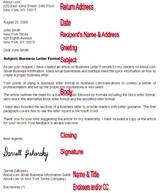
You can simplify the entire process of creating a properly formatted business letter by using your word processing program. In Microsoft Word, you can use the letter wizard by going to the “Tools” function, select “Letters & Mailings” and click on the Letter Wizard. The wizard will prompt you through each field and allow you to choose a format.
Using the proper business letter format is one step in making your business more professional. Take the time to make the right impression with your business.
reference :
http://sbinformation.about.com/od/bizlettersamples/a/letter-format.htm
Selasa, 01 Juni 2010
KUTIPAN
Kutipan adalah adalah gagasan, ide, pendapat yang diambil dari berbagai sumber. Proses pengambilan gagasan itu disebut mengutip. Gagasan itu bisa diambil dari kamus, ensiklopedi, artikel, laporan, buku, majalah, internet, dan lain sebagainya.
- Kutipan langsung
- Kutipan tidak langsung
- kurang dari empat baris ditulis sebagai bagian dari kalimat dengan memberikan suatu tanda yaitu tanda kutip untuk pembuka dan penutup dan tanda kutip penutup diberikan setelah titik penutup kalimat .permulaan kutipan itu harus menggunakan huruf kapital.
- lebih dari empat baris cara penulisannya yaitu tersendiri,menjorok kedalam setelah lima ketukan,dengan jarak baris satu spasi.
- Nama pengarang, diurutkan berdasarkan huruf abjad (alfabetis). Jika nama pengarang lebih dari dua penggal nama terakhir didahulukan atau dibalik.
- Tahun terbit buku, didahulukan tahun yang lebih awal jika buku dikarang oleh penulis yang sama.
- Judul buku, dimiringkan tulisannya atau digaris bawahi.
- Data publikasi, penerbit, dan tempat terbit.
- DAFTAR PUSTAKA ditulis dengan huruf kapital semua dan menempati posisi paling atas pada halaman yang terpisah.
Sabtu, 29 Mei 2010
OUTLINE ( KERANGKA KARANGAN )
Kerangka karangan adalah rencana teratur tentang pembagian dan penyusunan gagasan. Kerangka karangan yang belum final di sebut outline sementara sedangkan kerangka karangan yang sudah tersusun rapi dan lengkap di sebut outline final
Pola alamiah dapat terbagi menjadi 3 yaitu :
Dinamakan pola logis karena memakai pendekatan berdasarkan jalan pikir atau cara pikir manusia yang selalu mengamati sesuatu berdasarkan logika.
Pola logis dapat dibagi menjadi 6, yaitu :
Urutan familiaritas dimulai dengan mengemukakan sesuatu yang sudah di kenal, kemudian berangsur – angsur pindah kepada hal – hal yang kurang di kenal atau belum di kenal. Dalam keadaan – keadaan tertentu cara ini misalnya di terapkan dengan mempergunakan analogi.
Urutan akseptabilitas mirip dengan urutan familiaritas. Bila urutan familiaritas mempersoalkan apakah suatu barang atau hal sudah dikenal atau tidak oleh pembaca, maka urutan akseptabilitas mempersoalkan apakah suatu gagasan di terima atau tidak oleh para pembaca, apakah suatu pendapat di setujui atau tidak oleh para pembaca
Selasa, 25 Mei 2010
TOPIK, TEMA, JUDUL
- Menarik untuk ditulis dan dibaca.
- Dikuasai dengan baik oleh penulis minimal prinsip-prinsip ilmiah.
Pembatasan sebuah topik mencangkup konsep, variabel, data, lokasi atau lembaga dan waktu pengumpulan data.
Contoh pembatasan topik:
“upaya pengembangan bibit unggul di kalangan petani”.
2. Tema harus diketahui/dipahami penulis.
3. Tema harus Bermanfaat.
4. Tema yang dipilih harus berada disekitar kita.
5. Tema yang dipilih harus yang menarik.
6. Tema yang dipilih ruang lingkup sempit dan terbatas.
7. Tema yang dipilih memiliki data dan fakta yang obyektif.
8. Tema yang dipilih harus memiliki sumber acuan.
2. Tanpa ada singkatan atau akronim,
3. Awal kata harus huruf kapital kecuali preposisi dan konjungsi,
4. Tanpa tanda baca di akhir judul karangan,
5. Menarik perhatian,
6. Logis,
7. Sesuai dengan isi8. Judul harus:.asli,relevan,provakitif,singkat